Salmon has always been an important cultural food for me, connecting me to my Finnish heritage. As someone who struggles with a sense of belonging, certain foods are a comforting connection to my family. Even during my ‘stricter vegetarian’ years I would grant myself a rare meal of salmon when I ached for home.
I just spent the past three weeks in Alaska supporting my sister in her move back to Europe. Together we watched the Alaskan salmon return to their streams to spawn, a true miracle in real life. Soon Jessi would return to her home continent to be closer to family, just as the salmon are returning to their spawning grounds.
It always felt strange to me to eat salmon without ever having caught one, like it was a missing puzzle piece. I could never properly honour the fish that nourished more than my body, but also my heart. Not properly, not fully, when it came in plastic packaging. And don’t get me started on the tragedy of farmed salmon.
And there was something else, some other reason that I couldn’t fully explain at the time, but with my sister and her partner, Drew, we agreed that we’d try to get me my first wild salmon.
They took me out to their local fishing spot, one that has fed them for over a decade, at the confluence of the dark waters of Jim Creek and the pale silty waters of Knik River. They taught me how to floss for salmon with a fly rod. It’s probably one of the least efficient ways to catch a fish, but a celebrated one. They promised me that the feeling of your first salmon on a fly rod was worth the toil. So I spent several evenings practicing, learning how to read the slight movements of the fishing line and hoping that perhaps the river would grant me one salmon if I was patient enough.
Evening after evening I tried. Cast after cast, until my shoulders where stiff and painful and my body frozen from the glacial melt waters. It was still early in the fishing season and some evenings were so quiet that it felt like casting into the emptiness. On one of the more promising evenings the fish were alive, jumping all around us, and I got six on the line but never managed to land one. Salmon fight hard, and my nerves would either get the most of me, or I was just unlucky and the small hook wouldn’t properly set and the salmon leapt free. As I walked back to shore I laughed in exasperation that they were just teasing me that night.
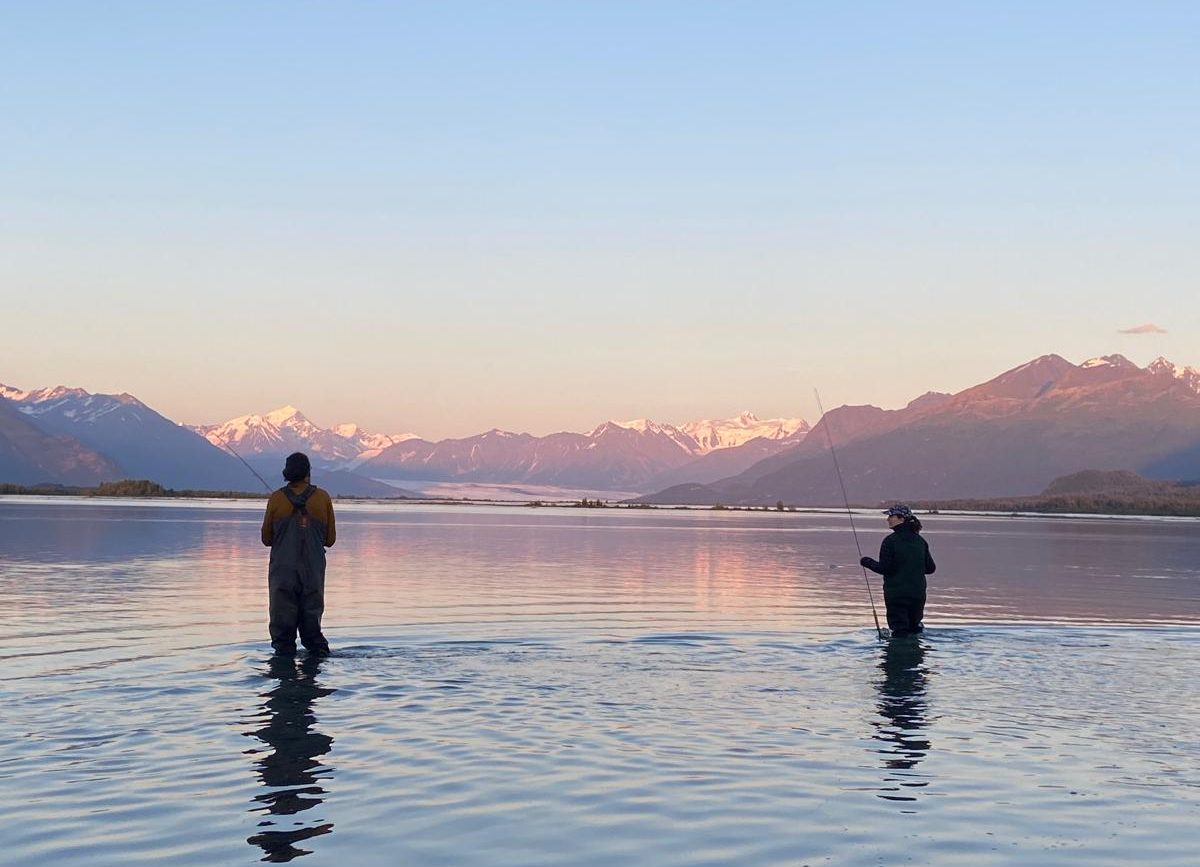
One of my last evenings and chances then arrived. I had spent nine hours on the Knik River at that point, carefully managing my hope and patience. This had turned into both a physical and an emotional challenge. And that evening the river didn’t seem promising; the good fishing spots had been claimed and the rest of the spots seemed quiet. Hours passed by, with only one slight bite on the line, and the time where we’d have to stop was quickly approaching (there was a 10pm cut off for legal fishing). With eight minutes to go I had accepted that it was looking like another failed evening.
And then I snagged something. Cue a massive adrenaline rush, the thrashing of the line while I repeated in my head ‘rod up, rod up!’. I slowly walked back to the shore holding my breath, step by step, bracing myself for the fish to jump off the hook with every shake. But he never did.
I couldn’t believe it. Drew ran up and grabbed him from the silty bank as my hands shook violently with adrenaline. After a total of 11 hours I managed to land a salmon. My first salmon.
Thank you salmon, thank you river. Thank you, thank you!
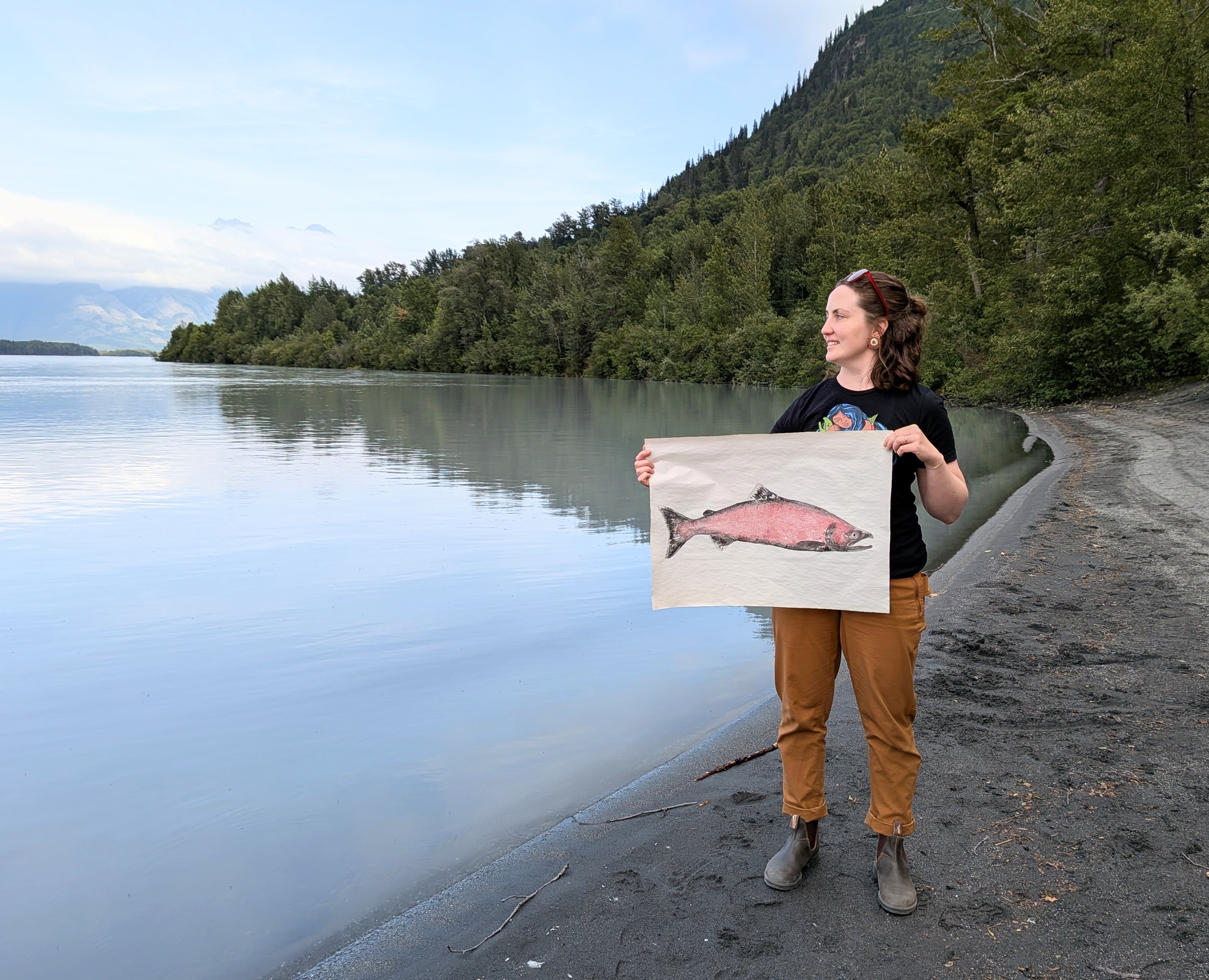
I hardly slept that night, the adrenaline and excitement had taken over. I remembered in the early hours of the morning the Japanese art of Gyotaku fish printing. And I knew I wanted to spend the following day honouring my first salmon through a print that I could keep as a reminder of everything I was feeling.
My sister agreed over our morning coffee that it was a worthwhile way to spend our day. As an artist she also had all the materials that we needed.
I thought I would cry when I finally caught my first salmon but the tears came on the day of printing. As I was preparing the salmon, I started to feel deep grief. I started to cry and asked my sister why I was feeling such deep sadness? ‘Because this is what we’ve lost’ she replied.
My sister and I spoke of the loss of these fish from our home waters. I wondered if my eventual children would ever know the feeling of catching their first salmon. The Alaskan populations are some of the remaining strongholds in the world and they are starting to struggle too. I cried and cried. Jessi explained that it was customary to these lands to give your first salmon to an elder. I cried some more.
I realised then that my fishing journey and the printing process was following a line of grief and mourning. Grief for the loss of our Atlantic salmon runs in European waters, and the social ecological ruptures that have followed. I searched online for whether there were any Finnish cultural practices around your first salmon catch. I couldn’t find any record of such. And while some salmon populations are barely holding on in the UK and Scandinavia we are dangerously close to monumental loss. And we have already lost so much it makes my heart ache.
But hope remains. I will always hope. And I will spend the rest of my life as I have spent the first part of it: in service to our wetlands and freshwaters and the species that we are intricately entangled with. I know there are so many others alongside me; family, friends, colleagues and communities that are working for better futures, and in my heart I know we can get there. Just as salmon beat immense odds in their return to their spawning rivers, we can get there.
I will be keeping my Gyotaku print as a reminder of my love for this world and as my ode to better futures. May our children know what it’s like to catch their first salmon. May we know the sights of salmon returning to our rivers to spawn in great boiling numbers. May we revive our forgotten traditions that celebrate our fish, rivers and communities with love and gratitude.