On Salmon, Grief and Hope

Salmon has always been an important cultural food for me, connecting me to my Finnish heritage. As someone who struggles with a sense of belonging, certain foods are a comforting connection to my family. Even during my ‘stricter vegetarian’ years I would grant myself a rare meal of salmon when I ached for home.

I just spent the past three weeks in Alaska supporting my sister in her move back to Europe. Together we watched the Alaskan salmon return to their streams to spawn, a true miracle in real life. Soon Jessi would return to her home continent to be closer to family, just as the salmon are returning to their spawning grounds.

It always felt strange to me to eat salmon without ever having caught one, like it was a missing puzzle piece. I could never properly honour the fish that nourished more than my body, but also my heart. Not properly, not fully, when it came in plastic packaging. And don’t get me started on the tragedy of farmed salmon. 

And there was something else, some other reason that I couldn’t fully explain at the time, but with my sister and her partner, Drew, we agreed that we’d try to get me my first wild salmon.

They took me out to their local fishing spot, one that has fed them for over a decade, at the confluence of the dark waters of Jim Creek and the pale silty waters of Knik River. They taught me how to floss for salmon with a fly rod. It’s probably one of the least efficient ways to catch a fish, but a celebrated one. They promised me that the feeling of your first salmon on a fly rod was worth the toil. So I spent several evenings practicing, learning how to read the slight movements of the fishing line and hoping that perhaps the river would grant me one salmon if I was patient enough. 

Evening after evening I tried. Cast after cast, until my shoulders where stiff and painful and my body frozen from the glacial melt waters. It was still early in the fishing season and some evenings were so quiet that it felt like casting into the emptiness. On one of the more promising evenings the fish were alive, jumping all around us, and I got six on the line but never managed to land one. Salmon fight hard, and my nerves would either get the most of me, or I was just unlucky and the small hook wouldn’t properly set and the salmon leapt free. As I walked back to shore I laughed in exasperation that they were just teasing me that night.
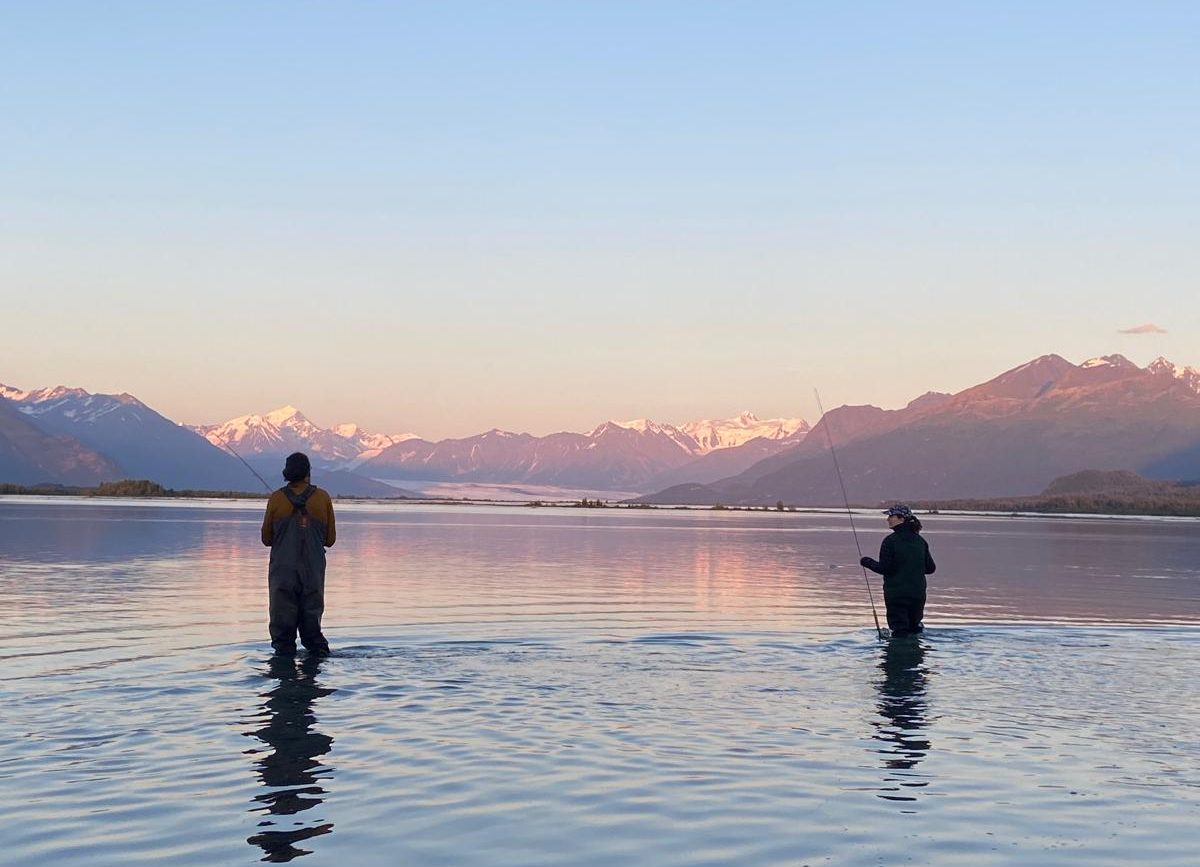
One of my last evenings and chances then arrived. I had spent nine hours on the Knik River at that point, carefully managing my hope and patience. This had turned into both a physical and an emotional challenge. And that evening the river didn’t seem promising; the good fishing spots had been claimed and the rest of the spots seemed quiet. Hours passed by, with only one slight bite on the line, and the time where we’d have to stop was quickly approaching (there was a 10pm cut off for legal fishing). With eight minutes to go I had accepted that it was looking like another failed evening. 

And then I snagged something. Cue a massive adrenaline rush, the thrashing of the line while I repeated in my head ‘rod up, rod up!’. I slowly walked back to the shore holding my breath, step by step, bracing myself for the fish to jump off the hook with every shake. But he never did.

I couldn’t believe it. Drew ran up and grabbed him from the silty bank as my hands shook violently with adrenaline. After a total of 11 hours I managed to land a salmon. My first salmon. 

Thank you salmon, thank you river. Thank you, thank you! 

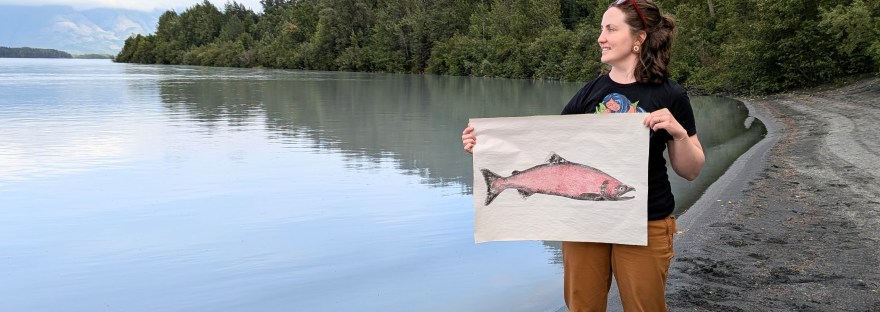
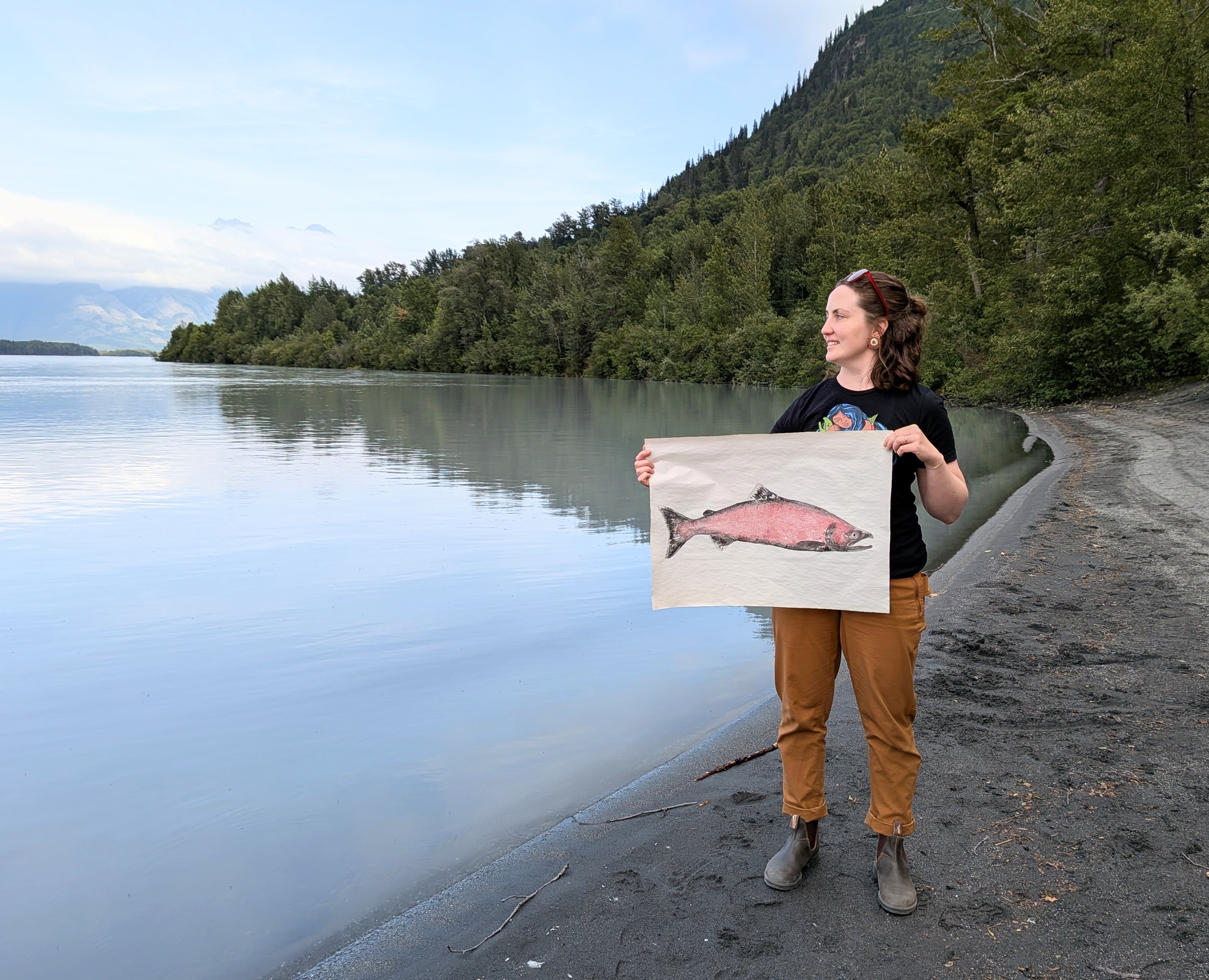
I hardly slept that night, the adrenaline and excitement had taken over. I remembered in the early hours of the morning the Japanese art of Gyotaku fish printing. And I knew I wanted to spend the following day honouring my first salmon through a print that I could keep as a reminder of everything I was feeling.

My sister agreed over our morning coffee that it was a worthwhile way to spend our day. As an artist she also had all the materials that we needed.

I thought I would cry when I finally caught my first salmon but the tears came on the day of printing. As I was preparing the salmon, I started to feel deep grief. I started to cry and asked my sister why I was feeling such deep sadness? ‘Because this is what we’ve lost’ she replied. 

My sister and I spoke of the loss of these fish from our home waters. I wondered if my eventual children would ever know the feeling of catching their first salmon. The Alaskan populations are some of the remaining strongholds in the world and they are starting to struggle too. I cried and cried. Jessi explained that it was customary to these lands to give your first salmon to an elder. I cried some more. 

I realised then that my fishing journey and the printing process was following a line of grief and mourning. Grief for the loss of our Atlantic salmon runs in European waters, and the social ecological ruptures that have followed. I searched online for whether there were any Finnish cultural practices around your first salmon catch. I couldn’t find any record of such. And while some salmon populations are barely holding on in the UK and Scandinavia we are dangerously close to monumental loss. And we have already lost so much it makes my heart ache.

But hope remains. I will always hope. And I will spend the rest of my life as I have spent the first part of it: in service to our wetlands and freshwaters and the species that we are intricately entangled with. I know there are so many others alongside me; family, friends, colleagues and communities that are working for better futures, and in my heart I know we can get there. Just as salmon beat immense odds in their return to their spawning rivers, we can get there.

I will be keeping my Gyotaku print as a reminder of my love for this world and as my ode to better futures. May our children know what it’s like to catch their first salmon. May we know the sights of salmon returning to our rivers to spawn in great boiling numbers. May we revive our forgotten traditions that celebrate our fish, rivers and communities with love and gratitude. 
Review of Anthropocene: The Human Epoch

On the 4th of June there was a screening of the documentary Anthropocene: The Human Epoch in Leicester city centre. These are my reflections, which I have been sitting on for a little while.

Anthropocene was an ode to large machinery. A glorification of the ‘human dominion’ of the world. With a dangerously lacking message, it turns into entertainment based on our collective destruction and the suffering that climate change is already bringing to communities across the world.

Why is there effort being put into naming this epoch the ‘Anthropocene’? What does this mean for anyone who is not an academic researcher? What does this mean for those communities rapidly watching their ancestral lands literally falling into the sea? Nothing was explained alongside the imagery of ‘impressive’ feats of engineering, such as the monster excavators of the Hambach coal mine.

The documentary ends with one message: we are all implicated. This was a perfect message for it to end on as it illustrates the whole film’s failure in grasping and communicating that we are not all implicated equally.

The fishing communities I work with in Indonesian Borneo are not as implicated as the mass-consuming communities of the West. The poacher that was so vilified in the documentary is not as complicit as those who have and still benefit from the colonial ransacking of Kenya. The documentary focuses on the tragic loss of elephants, and yet ignores one of the biggest causes of deforestation and environmental degradation worldwide: the livestock industry. Let us also not forget that 100 companies are responsible for 71% of all greenhouse gas emissions. By ignoring these issues, the documentary, whether its makers like it or not, turns political, for the filmmakers have made conscious decisions on what they believe is worth showing as a story of our world.

The filmmakers say they didn’t want to create a ‘divisive’ film that points fingers (1). But until we can have honest conversations about where the real responsibility of climate change and environmental destruction lie (hint: it’s not with the elephant poachers), we will not find a solution. Of course, the direct and lethal impacts of climate change have come sooner to those already marginalised in this world. It hits communities of colour, and indigenous communities first. It hits everyone other than those who are truly the most implicated, first. It’s a tough thing pointing the finger at those in power, and at the political-economic system that we have all become entrenched in. By not doing so, the documentary is a total cop out.

I was also shocked at the portrayal, or complete lack of portrayal, of resistance against these extractive industries. The documentary shows very little of the efforts done worldwide in the fight for environmental and social justice. Taking the Hambach coal mine, the documentary portrays a scene of inevitability: the last three families with little to no hope of saving what’s left of their village. It completely ignored that last year saw some of the biggest demonstrations to try to stop the expansion of the coal mine and protect what is remaining of Hambach forest. A reported 50,000 people flocked to the area turning the Hambach forest into a symbol in the international anti-coal movement. People have been inhabiting that forest for over six years and there continues to be active resistance against the coal mining operations and expansion to this day. Not showing that there are people actively fighting for our futures robs anyone watching this documentary of hope and empowerment. If we want to look at the ‘power of people’ we cannot continue to gawk at our destructive power, instead we must look towards our collective power to fight for a better world – indeed, to fight for our survival.

We also need to look more broadly at this documentary and what it represents. The website promoting it calls it ‘a cinematic meditation on humanity’s massive re-engineering of the planet’. This is the most disgusting use of words: it is not a cinematic meditation, it is a traumatic reliving of the constant, terrifying and unjust extirpation of the world as we know it for the gain of the few, wealthy and powerful elites. The description of the documentary from its website is as follows:

the filmmakers have traversed the globe using high end production values and state of the art camera techniques to document evidence and experience of human planetary domination…. At the intersection of art and science, ANTHROPOCENE: The Human Epoch witnesses in an experiential and non-didactic sense a critical moment in geological history — bringing a provocative and unforgettable experience of our species’ breadth and impact.

But exactly who gets to watch this documentary as an artwork, a cinematic experience? Who gets to analyse its imagery as some sort of provocation? It surely is not the mining communities in Russia. Or those workers felling trees in Canada. Or the poacher hunting elephants. I am not stunned by the visuals of the documentary, but of the lack of self-awareness in the making of it.

Climate change kills. People are literally dying.

My rejection of this documentary is also personal. I was left feeling such disempowerment and frustration at the end of that screening that it was clear to me that I cannot watch documentaries like this anymore. Along with the many other researchers and activists worldwide, I literally must work every single day of my life to keep hope through my work. I cannot watch any more documentaries which makes this harder for me.

Many people are still in search of how they can find hope, and with the documentary providing no directions at all my fear is people will walk away from it in the way they have been trained over a lifetime: by shutting off those emotions, and accepting the dangerous idea that it’s just too big for them to do anything about.

We don’t need a ‘wake-up call’ – the threat and reality of climate change is very, very clear. The time for documentaries to ‘raise awareness of the state of the planet’ is long gone.

We need documentaries that are a call to action. At this point in time, anything less than that is dangerous.

The event in Leicester city centre ended with a group discussion. It was complete with the typical characters: the white woman asking how those working in the timber industry don’t feel guilt, the white man nihilistically proclaiming that everything is going to be f%&!ed anyways, and all us academics in all our privilege performing our mental gymnastics about whether or not media should be ‘political’.

We must do better.

  1. (https://www.sierraclub.org/sierra/inside-anthropocene-film

Facing the fires: when they consume more than peat

We need to talk about the mental health impacts of Indonesia’s peatland fires.

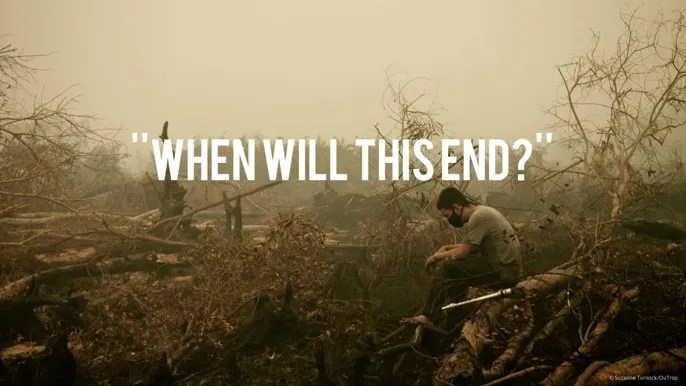
Sebangau Forest in Indonesia was were I found exactly what I wanted to do, and it has also been a place of great personal growth over my years returning to it. I was only 19 years old when I first came to the research camp, and four years later would be the first time I would face the real fear of it burning down: for all it represents to me. Fieldwork is always challenging, but for me 2015 was tainted by several traumas, the last one being the disastrous fires that eventually forced me to leave Borneo. I could heal from the others, but that last one has been particularly tough to deal with.

The 2015 fires and haze disaster in Indonesia was described as the greatest environmental disaster of the 21st century. Toxic smoke covered Indonesia, Malaysia, Brunei, Singapore and even Thailand – you could see it from space. It potentially caused the premature deaths of over 100,000 people in the region. Sebangau Forest lost 10% of its forest cover.

Upon my return to the UK in 2015, while the fires were ongoing, I wrote the following in a blog post explaining some of what it’s like in the haze:

Living in the haze, you are aware that what you are breathing is harming you – you can see it and feel it. Your eyes are constantly irritated and even indoors you can see the thick smoke haze hanging in the air in an acrid cloud. I experienced breathlessness and chest pains even when I was just sitting down. But dust particles are not your only worry when living in haze: carbon monoxide levels have also been off the scale, with Jakarta Post reporting that in Palangkaraya “people were in grave danger of dying painful deaths from carbon monoxide (CO) poisoning”. The dangers are therefore invisible as well.

Living in the haze was what I imagine living in a post-apocalyptic world to be like; you just have to look at the photos if you think this is an exaggeration. Living in these conditions makes you inevitably suffer not only physically, but mentally as well. My colleagues and I have experienced prolonged and significant stress, fatigue, and desperation to leave, and I cannot begin to imagine the mental health impacts of people who face the haze every single year.

When I finally arrived back in the UK my relief was met with a guilt that I have never experienced before. I think of Palangkaraya, my friends, my research assistants and their children, and the fresh air here is a bitter comfort with the memory of what they are experiencing back in Indonesia. 

There was a time when the fires really knocked the hope out of me and I eventually sought the help of a therapist to help get through the worst of it. And while I have found ways to find hope in other aspects of my life and work, the return of the fires every year doesn’t make it any easier. I wonder how many others have struggled as well.

As researchers we need to talk about the psychological implications of watching places that we study and that we love, burn. Or melt, or bleach, or collapse.

There is a whole lot of privilege associated with my experiences of mental health, the peatland fires, and my ability to seek out professional help. Millions of people aren’t in the same position. I know that many Indonesians go along as normal during the fire season (this has in itself so many layers to it), but with increasing awareness of the health dangers of fires and haze, with increasing experiences of environmental degradation in addition to climate change, mental health will certainly become more of an issue.

I do not live in Indonesia anymore, and I certainly haven’t experienced the fires every single year of my life as so many have. The families living on peatlands across Indonesia and the firefighters that tirelessly fight them every year will be greatly suffering in more ways that one. We need to uplift those voices and start centring them in our discussions about the impacts of fires in Indonesia and beyond. This isn’t only about carbon dioxide emissions, forest loss, impacts on GDP and the economy. As Idrus, a CIMTROP patrol team member and firefighter described in a recent blog post and article his experience of the 2019 fires:

“The hot winds blow against my face and I’ve been breathing in toxic smoke for more than two months. I can feel the anger of many people in my village. I am angry; my family is suffering from the fires and smoke too… I am exhausted and haunted by this fire even in my dreams.” 

“I feel totally consumed by fire. I live, eat, sleep, dream fire.”

Idrus, Sebangau, Central Kalimantan 2019

While the literature on mental health linked with peatland fires and haze is pretty non-existent, there has been research conducted on fires and resulting mental health impacts in other countries:

  • Australia: Mental health impact of bushfires in an Australian community. Twelve months after the fires, 42% of the population exposed to wildfires were classified as potential psychiatric cases – more than double that seen in the non-exposed population.
  • California: A study of 357 patients who sought healthcare assistance (therefore not a random sample of exposed persons) after the 2003 Californian wildfires also gives a dramatic picture, with 33% showing symptoms of major depression and 24% showing symptoms of Post Traumatic Stress Disorder. Another study of 30 adults 6 weeks post exposure to wildfires showed increased levels of posttraumatic stress, depression, and anxiety symptoms.
  • Greece: A cross sectional case control study looked at those affected by the Greek wildfires of 2007. Increased symptoms of somatisation, depression, anxiety, hostility, and paranoia were found in those who were victims of the fire compared with controls.

As we collectively witness the increasing impacts of climate change on our communities across the world, this is going to get harder. Some people will be more heavily impacted than others. Some will have more access to help than others. Fighting those inequalities has to be a focus for us all.

When I look at my own research community, and the papers that describe and document the impacts of peatland fires, mental health has garnered little attention. But if we want to talk about resilient socio-ecological systems, if we want to talk about environmental justice and healthy communities, we need to talk about mental health.

And in the end, the only thing that helped me face the fires, was talking about it.